
How to Choose a WordPress Developer for HVAC Companies?
Choosing a WordPress developer for HVAC companies involves more than comparing website designs or selecting the lowest quote. The right professional should understand your business goals, create a website that works well on mobile devices, implement appropriate SEO foundations, and make it easy for potential customers to contact your company.
Before hiring anyone, evaluate their relevant portfolio, technical skills, communication, pricing, website ownership policies, and post-launch support. A developer does not need to specialize exclusively in HVAC, but experience with service-based businesses can help them understand the practical requirements of an HVAC website.
This guide explains what to look for, which questions to ask, and how to compare candidates before making a decision.
Before evaluating developers, it helps to understand what an effective HVAC website should include. Our HVAC website design guide explains the essential elements to consider when planning a professional website for your heating and cooling business.
If you need professional help building a website for your heating and cooling business, explore our HVAC web design services to learn more about our approach.
Table of Contents
1. Look for Experience With HVAC and Service-Based Businesses
An HVAC website has different requirements from a personal blog, online magazine, or general corporate website. Visitors may want to find a particular service, check the areas served, call the business, or request a quote without navigating through unnecessary pages.
A developer familiar with service-based businesses should understand how to organize information around these needs.
Look for experience creating websites with:
Individual pages for important heating and cooling services.
Clear contact details and prominent call-to-action buttons.
Mobile-friendly click-to-call functionality.
Quote request and contact forms.
Service-area information where appropriate.
Customer testimonials or verified reviews.
Clear navigation and accessible page layouts.
For example, a residential HVAC company might prioritize emergency contact information and service request forms. A commercial mechanical business might need more detailed information about its capabilities, industries served, and project experience.
Ask potential developers whether they have worked with similar business models and how they would approach your requirements.
Important: Industry experience is valuable, but it is not the only qualification that matters. A skilled WordPress developer with strong service-business experience and a clear understanding of your brief may be a better choice than someone who simply claims to specialize in HVAC.
2. Evaluate the Developer's Portfolio Carefully
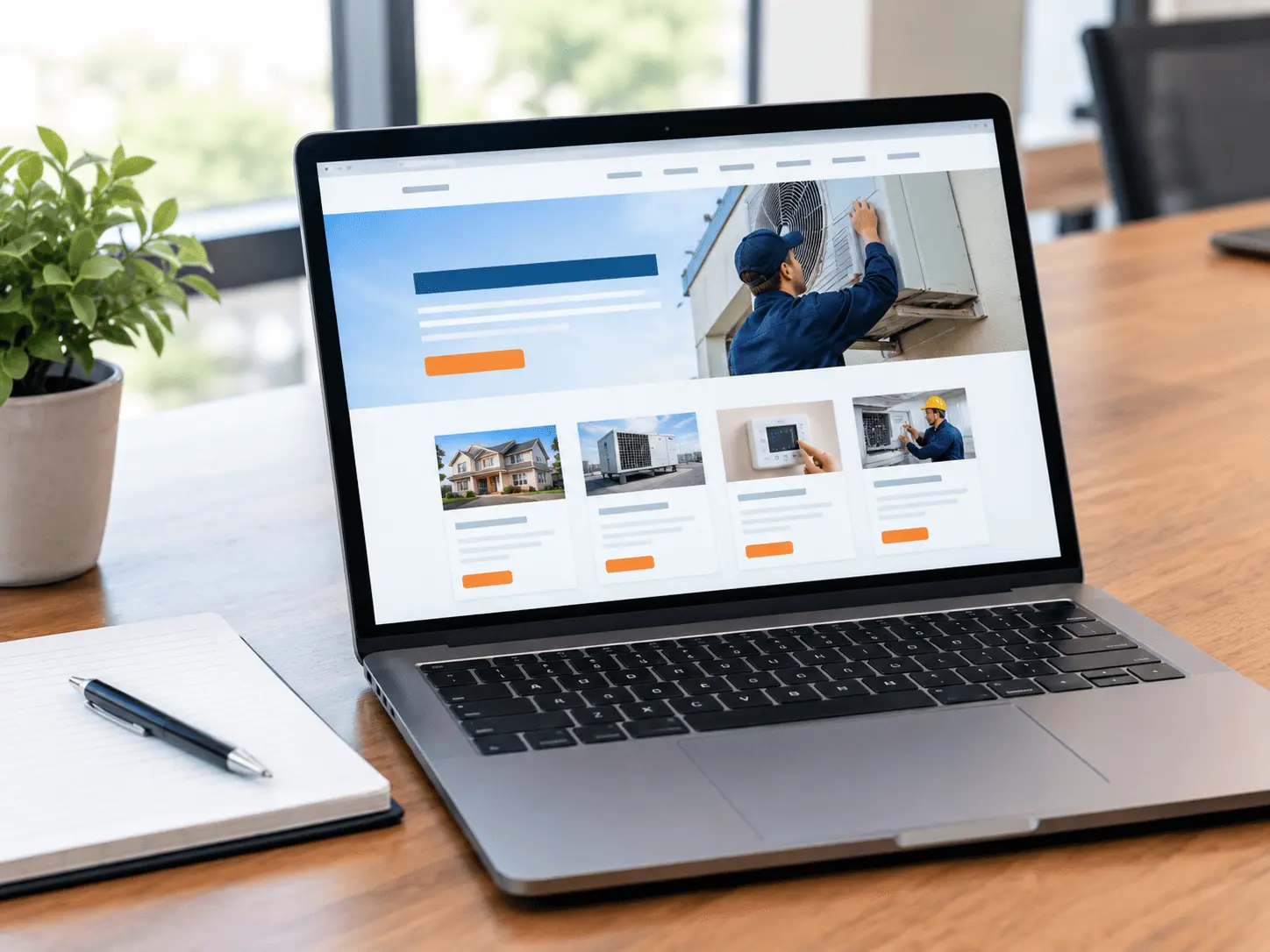
A portfolio helps you assess whether a developer can produce the quality and functionality your business needs. However, do not judge a website solely by its homepage or visual appearance.
Review several live websites, preferably projects with requirements similar to yours.
What should you check?
Design and usability: Are the layouts professional, readable, and consistent? Can visitors find services and contact information quickly?
Mobile responsiveness: Open the websites on your smartphone. Check whether the text is readable, buttons are easy to tap, navigation works, and forms fit the screen.
Service-page structure: Look for clear headings, useful service descriptions, appropriate images, and logical internal links.
Conversion elements: Check whether visitors can call the business, request a quote, or submit an enquiry without unnecessary friction.
Performance: Test representative pages using Google PageSpeed Insights. Look at loading performance, responsiveness, and layout stability, rather than relying on appearance alone.
Accessibility: Check basic usability, including keyboard navigation, form labels, readable contrast, and descriptive link text.
Do not assume that every feature or result on a portfolio website was produced by the developer. Ask which parts they personally handled, whether the site is still maintained, and whether the examples are available for review.
If the developer cannot share relevant projects because of confidentiality agreements, ask for a demonstration of comparable work or a detailed explanation of their process.
If your existing website looks outdated or is difficult to use on mobile devices, our HVAC website redesign services may help you explore ways to improve its design and usability.
3. Check Their WordPress Development Skills
A professional WordPress developer should be able to explain how they will build and maintain your website, not just how they will make it look attractive.
The required technical depth depends on your project. A straightforward brochure website may not need extensive custom programming, while a complex booking system or CRM integration may require more advanced development.
Evaluate the following capabilities.
Theme and page-builder knowledge
Ask which theme and page builder the developer proposes to use and why. They should explain the trade-offs in usability, flexibility, maintenance, and performance.
A website built with a suitable theme and a well-managed page builder can be effective without unnecessary custom development.
Plugin selection
Plugins can provide forms, SEO functionality, caching, security, and other features. However, installing more plugins is not automatically better.
Ask how the developer chooses plugins, checks compatibility, handles licensing, and avoids overlapping functionality.
Custom development and integrations
If your website needs a CRM, booking tool, email marketing platform, or another business system, ask whether the developer can implement and test the integration.
Clarify which features require custom code, which depend on third-party services, and whether additional subscriptions or API fees apply.
Maintainable code
For custom development, ask how the developer handles testing, documentation, updates, and future changes. The goal is to ensure that another qualified professional can maintain the website if your original developer becomes unavailable.

4. Assess SEO Knowledge and Website Performance
A visually attractive website may still have problems with search accessibility, page structure, performance, or content organization.
Your developer should understand the technical and on-page SEO foundations of a WordPress website.
These include:
Logical page hierarchy and heading structure.
Descriptive page titles and meta descriptions.
Search-engine-accessible content and links.
XML sitemap and indexing configuration where appropriate.
Image sizing, compression, and descriptive alternative text.
Appropriate redirects when URLs change.
Mobile usability and performance optimization.
Basic technical checks after launch.
Google’s SEO Starter Guide explains how clear site organization, descriptive URLs, useful content, and crawlable links help search engines understand a website.
Performance should also be evaluated with real measurements. Google’s Core Web Vitals cover loading performance, responsiveness, and visual stability. See web.dev’s Core Web Vitals guidance.
Ask the developer how they will measure performance before and after launch. Be cautious of anyone who guarantees a particular Google ranking or claims that a single plugin will automatically make your website fast.
Also clarify whether SEO means implementing technical foundations or providing an ongoing service involving keyword research, content strategy, local SEO, and performance monitoring. These are related but distinct scopes of work.
Understanding the benefits of professional HVAC website design can also help you evaluate whether a developer’s proposed approach supports your business goals, including usability, credibility, and customer enquiries.
For businesses that need help improving their local search visibility beyond website development, explore our HVAC local SEO services.
5. Check Security, Backups, and Maintenance
Launching your website is not the end of the project. WordPress core software, themes, and plugins need appropriate maintenance, and your business needs a recovery plan if something goes wrong.
Ask the developer:
How will the website be backed up?
Where will backups be stored?
How frequently will backups run?
How will updates be tested?
What happens if an update breaks the website?
What security measures are included?
Who will respond if the website becomes unavailable?
The official WordPress security hardening documentation discusses access control, trusted software sources, updates, and backup preparation.
A maintenance arrangement should specify the tasks included, how often they are performed, and whether troubleshooting or emergency repairs incur additional charges.
Avoid assuming that a security plugin or automatic backup alone makes a website completely secure. Good maintenance combines sensible configuration, timely updates, reliable backups, and a recovery process.
6. Confirm Website Ownership and Administrative Access
Before hiring a WordPress developer, establish who will own and control the website after launch.
Ideally, your business should retain control of its domain registration, hosting account, WordPress administrator access, and other essential business assets.
Ask for written clarification about:
Domain and hosting ownership.
Administrator credentials and access.
Ownership and licensing of custom code and design work.
Premium theme and plugin licenses.
Third-party integrations and subscription fees.
Website files and database backups.
Access to analytics and search performance tools.
The process for transferring the website to another developer.
Some developers purchase licenses under their own agency accounts, which may be reasonable for certain arrangements. However, you should understand what happens if the working relationship ends and whether you will need to purchase your own licenses.
Never assume that paying for a website automatically transfers every third-party license or intellectual property right. Review the contract and confirm the relevant terms before the project begins.
7. Understand WordPress Website Costs for HVAC Companies
There is no single price that applies to every HVAC website. The cost depends on the scope, design requirements, functionality, content, integrations, and level of ongoing support.
A basic informational website may require substantially less work than a large commercial HVAC website with many service pages, custom functionality, and external integrations.
| Cost factor | What to clarify |
|---|---|
| Page count | How many pages are included? |
| Design | Is the design template-based, customized, or fully bespoke? |
| Content | Who writes and supplies the copy? |
| SEO | Which technical and on-page SEO tasks are included? |
| Functionality | Are forms, booking systems, or integrations required? |
| Performance | What testing and optimization are included? |
| Maintenance | Is ongoing support included or billed separately? |
| Licensing | Which annual or monthly subscriptions will you pay? |
Request a written proposal with deliverables, milestones, payment terms, exclusions, and a clear process for handling additional requests.
Compare the total cost of ownership, not just the initial development fee. A cheaper proposal may exclude content, testing, training, or ongoing maintenance, while a higher quote may include these services.
If you are comparing several developers, ask each to quote against the same project brief. This makes it easier to understand the differences in scope and value.
Before choosing a provider, review our HVAC website design pricing to compare available options and determine which service best fits your requirements and budget.
8. Ask These Questions Before Hiring a Developer
Use these questions during an initial consultation or proposal review.
Have you built websites for HVAC or other service-based businesses?
Can I review live examples of your work?
What theme, page builder, and plugins do you recommend, and why?
How will you make the website usable on mobile devices?
What SEO and performance tasks are included?
Who will supply the website content and images?
How will backups, security, and software updates be handled?
Will my business retain administrator access and control of its domain and hosting?
What is included in the quoted price, and what costs extra?
What support is available after launch?
Pay attention to how the developer answers, not simply whether they say yes.
A good candidate should explain their approach clearly, identify limitations, ask relevant questions about your business, and distinguish confirmed deliverables from optional improvements.

9. Watch for These Common Hiring Mistakes
Several mistakes can create unnecessary costs or complications later.
Choosing only by price: A low quote is not necessarily poor quality, and a high quote is not necessarily better. Compare the scope, technical approach, communication, and support.
Ignoring mobile usability: A website should work for visitors using different screen sizes and input methods. Review the actual experience rather than relying on a desktop preview.
Accepting vague promises: Statements such as “fully SEO optimized” or “100% secure” are not substitutes for specific deliverables. Ask what will actually be done and how it will be checked.
Overlooking ownership: Make sure you understand who controls the domain, hosting, accounts, licenses, and completed work.
Skipping a written agreement: Document the scope, timeline, revisions, payment schedule, responsibilities, and post-launch arrangements.
Failing to plan for maintenance: Establish who will update the website, monitor important functions, and restore it if a problem occurs.
A transparent process reduces misunderstandings and helps you make a more informed decision.
10. Compare Candidates Using a Simple Evaluation Checklist
Once you have spoken with several developers, use the same criteria to assess each candidate.
| Evaluation criterion | What good evidence looks like |
|---|---|
| Relevant experience | Comparable live projects and clear explanations of their role |
| Portfolio quality | Usable, responsive, well-structured websites |
| Technical capability | Appropriate tools, maintainable implementation, and tested functionality |
| SEO and performance | Defined tasks and measurable checks |
| Security and maintenance | Documented backup, update, and recovery arrangements |
| Communication | Clear answers, realistic timelines, and written proposals |
| Ownership | Explicit access, licensing, and transfer terms |
| Pricing | Itemized scope, exclusions, and ongoing costs |
Give each candidate a rating from 1 to 5 for each criterion. You can weight the criteria according to your priorities, but do not let a high total score override serious concerns about ownership, security, or communication.
For example, a developer with an impressive portfolio but unclear ownership terms may be a riskier choice than someone with slightly less polished examples and a much clearer delivery and handover process.
The objective is not to find a perfect score. It is to select a developer whose skills, working methods, and commercial terms fit your business.
Frequently Asked Questions
The cost varies according to the number of pages, design complexity, content requirements, integrations, SEO scope, and maintenance arrangements. Request itemized proposals based on the same brief rather than relying on a generic price estimate.
An HVAC specialist may understand the industry's service-page requirements, customer journeys, and lead-generation needs. However, a developer with strong service-business experience and the right technical skills may also be suitable. Evaluate actual work and process rather than relying on a niche label alone.
Look for WordPress development skills, responsive design, plugin selection, performance optimization, security awareness, basic SEO implementation, and clear project communication. Additional skills may be necessary for custom integrations or advanced functionality.
No. A well-built website provides a useful technical foundation, but rankings depend on many factors, including content relevance, competition, search intent, site accessibility, and other signals. No developer can guarantee a specific ranking.
Your business should retain appropriate control of its domain, hosting, administrator access, and essential website assets. Written agreements should also explain intellectual property rights, third-party licenses, and how the site can be transferred.
Most WordPress websites need continuing attention to software updates, backups, security, compatibility, and functionality. The appropriate maintenance arrangement depends on your site's complexity and the support you can manage internally.
Ask them to explain their proposed page structure, metadata, indexing checks, image optimization, internal linking, and performance testing. Request specific deliverables and ask how they will verify the implementation.
A freelancer may offer direct communication and a flexible working arrangement. An agency may provide access to a wider range of specialists. Neither is automatically better. Compare relevant skills, availability, accountability, project scope, and ongoing support.
Conclusion: Choose a Developer Who Understands Your Business
Choosing the right WordPress developer for your HVAC company means evaluating more than design quality and price. Relevant experience, technical skills, mobile usability, SEO foundations, security, ownership, communication, and ongoing support all deserve attention.
Review live projects, ask detailed questions, compare written proposals, and establish clear expectations before paying a deposit. A reliable developer should be able to explain what they will deliver, what falls outside the scope, and how your business will manage the website after launch.
If you are exploring professional website development for your heating and cooling business, visit HVAC Web Design Lab’s HVAC Web Design services to learn more about the available service. You can also review your requirements and compare providers before deciding whether to hire a specialist.
The best choice is the professional who can demonstrate the right capabilities, communicate transparently, and deliver a website that fits your business needs.
If you have questions about your project or want to discuss your website requirements, contact HVAC Web Design Lab to explore your options.

About the Author
Tanvir Siddiki
Founder & HVAC Web Design SpecialistTanvir is the founder of HVAC Web Design Lab, specializing in website design, website redesign, and local SEO for HVAC businesses. He focuses on creating professional, user-friendly websites that help heating and cooling companies strengthen their online presence.
One Comment